

Overview of Prakas Governs Issuance of Occupancy Certificates for Constructions Built Prior to the Construction Law
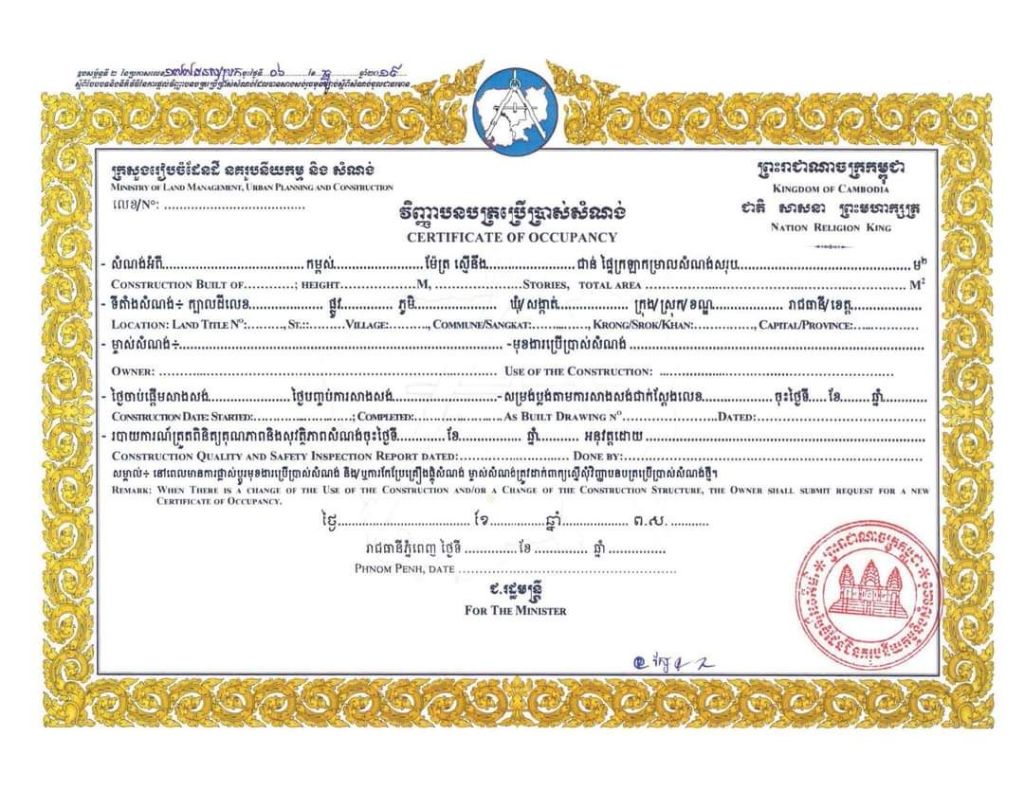
Sample of Certificate of Occupancy
Issuance of Occupancy Certificates for Existing Constructions under Prakas No. 177
On 6 December 2019, the Ministry of Land Management, Urban Planning and Construction (“MLMUPC”) issued Prakas No. 177 on the Formalities and Procedures for the Issuance of Occupancy Certificates for Constructions Built Prior to the Enforcement of the Construction Law (“Prakas No. 177”).
This Prakas aims to promote the overall quality, safety, security, public order, aesthetic appeal, and environmental protection of constructions from the perspective of owners, users, and the general public. It also seeks to prevent constructions that fail to meet the prescribed safety and quality standards.
Prakas No. 177 sets out the formalities and procedures for the issuance, suspension, and revocation of occupancy certificates for buildings constructed prior to the enactment of the Construction Law on 2 November 2019. The types of constructions covered by this Prakas include:
- Constructions built without a permit;
- Constructions that deviate from the terms of their permits; and
- Constructions built with a permit but without obtaining either a compliance certificate or a site closing permit.
Within two years of the Construction Law’s entry into force, owners of qualifying constructions must apply for an occupancy certificate from the MLMUPC at the national, provincial, district, or khan level. An occupancy certificate may be granted only if the structure poses no danger to users or the public and does not negatively impact public order.
Notably, owners of constructions built before 20 December 1997 may also apply for an occupancy certificate. However, for constructions completed after 3 April 2015, the issuance of an occupancy certificate is contingent upon the payment of provisional fines, in accordance with Sub-Decree No. 42 dated 3 April 2015 on Urbanization of the Capital, Municipalities, and Urban Areas.
Applications must be submitted using the prescribed form attached to Prakas No. 177 and must include all required supporting documentation.
The occupancy certificate may be suspended or revoked if a post-inspection report finds deficiencies in quality or safety.
Finally, any individual affected by a decision related to the issuance, suspension, or revocation of an occupancy certificate has the right to appeal to the competent authority or to the court.
Prakas No. 177 on the Formalities and Procedures for the Issuance of Occupancy Certificates for Constructions Built Prior to the Enforcement of the Construction Law dated 6 December 2019.

PHENG Sopheap
This summary is for informational purposes only and does not constitute legal advice. It is not comprehensive, and readers should seek professional legal consultation for their specific circumstances. SOPHEAPCAMBOLAW retains full ownership of this content. Unauthorized reproduction, distribution, or use of any part of this article without prior written approval is strictly prohibited.
សព្វទានំ ធម្មទានំ ជិនាតិ
-ព្រះពុទ្ធ-
 SOPHEAP CAMBO. LAW
Leave a comment